Nexgent Trading Engine
Nexgent is an open-source, self-hosted trading automation framework for Solana. Deploy your own instance, create trading agents, and execute trades with ultra-low latency.
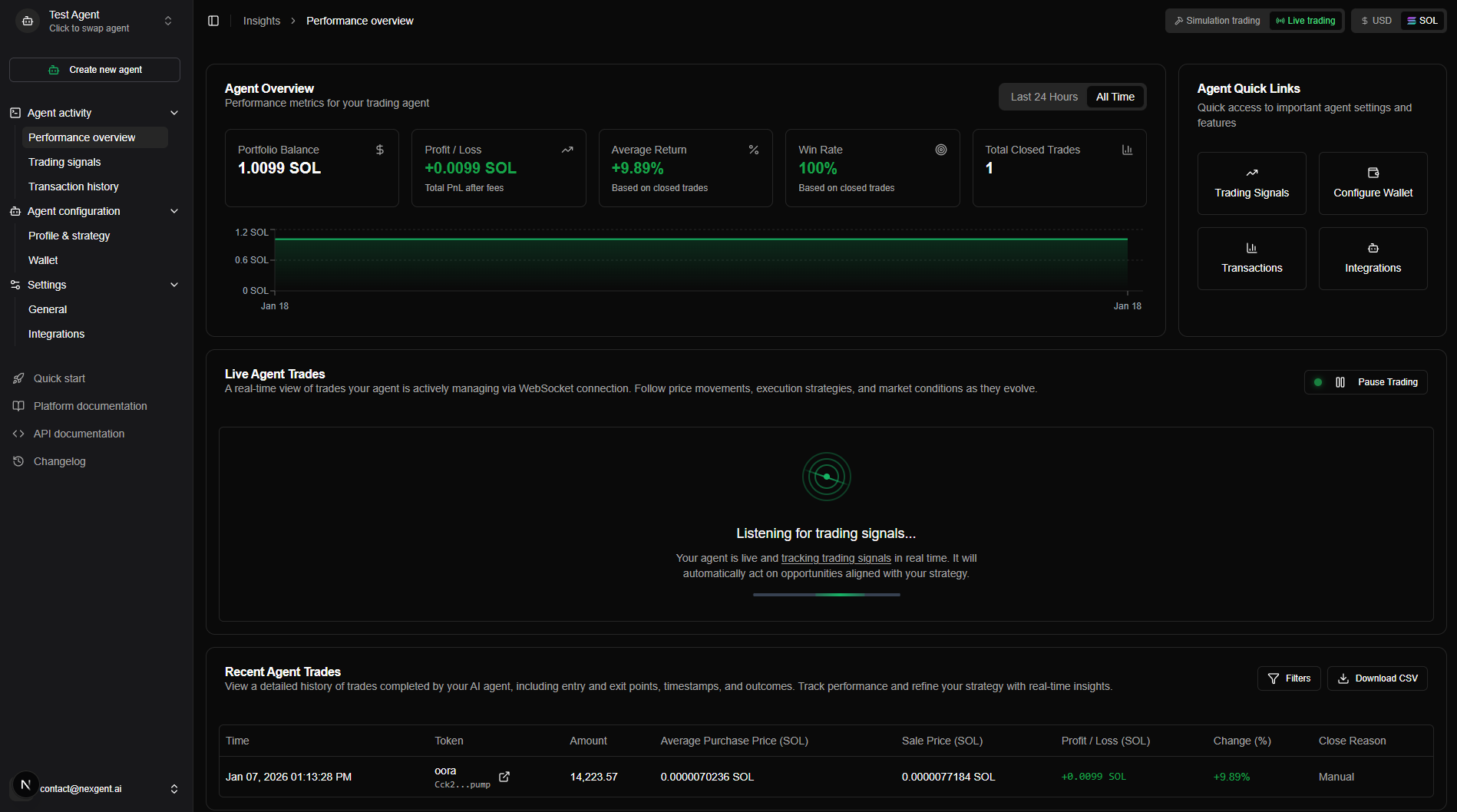
Trading dashboard showing performance metrics, live positions, and balance history
Why Nexgent?
| Feature | Description |
|---|---|
| Self-Hosted | You deploy and control your own instance. Your data, your keys, your infrastructure. |
| Open Source | Full source code access. Audit, modify, or extend any feature. |
| No Fees | Zero per-transaction fees. Only pay Solana network costs. |
| Ultra-Fast | Sub-500ms signal processing, sub-1ms stop loss evaluation. |
How It Works
Signal → Agent Eligibility → Trade Execution → Position Monitoring- Signal Creation – Trading signals arrive via API
- Agent Evaluation – Each agent checks eligibility (balance, config, filters)
- Trade Execution – Eligible agents execute via Jupiter Aggregator
- Position Management – Real-time monitoring with stop loss, take-profit, DCA, and auto-close
All state changes broadcast via WebSocket for live dashboard updates.
Key Features
Trading Automation
- Automated trade execution based on configurable rules
- Multiple agents with independent strategies
- Signal filtering by strength, whitelist, and blacklist
- Position sizing based on balance categories
Risk Management
- Trailing stop loss with 4 calculation modes (fixed, exponential, zones, custom)
- Take profit with preset or custom levels and optional moon bag
- DCA (Dollar Cost Averaging) to average down on dips
- Stale trade detection for auto-closing idle positions
- Maximum position limits to prevent overexposure
Real-Time Monitoring
- WebSocket updates for live position tracking
- Price feeds from Jupiter and Pyth
- Performance metrics and historical swap analysis
- Balance tracking across simulation and live wallets
Simulation Mode
- Risk-free testing with virtual wallets
- Real price data for accurate P&L simulation
- Strategy validation before going live
- Separate automation toggles for sim vs live
Technology Stack
Nexgent is built as a TypeScript monorepo with three packages:
| Package | Purpose |
|---|---|
nexgent-open-source-trading-engine/backend | Express API, WebSocket server, trading engine |
nexgent-open-source-trading-engine/frontend | Next.js 15 dashboard with real-time updates |
nexgent-open-source-trading-engine/shared | Shared types, validators, utilities |
Core Technologies:
- Runtime: Node.js 18+
- API: Express.js with JWT authentication
- Database: PostgreSQL with Prisma ORM
- Cache: Redis for high-performance caching
- Frontend: Next.js 15 with React Query
- Trading: Jupiter Aggregator for swaps
- Prices: Jupiter & Pyth Network
Quick Start
Get Nexgent running locally in 15 minutes:
git clone https://github.com/nexgent-ai-org/nexgent-open-source-trading-engine.git
cd nexgent-open-source-trading-engine
docker-compose up -d
pnpm install
pnpm dev
Then open http://localhost:3000 to access the dashboard.
See the Quickstart (Local Dev) or Quickstart (Cloud Hosting) for complete setup instructions.
Documentation Sections
For New Users
Getting Started as a Trader
- Quickstart (Local) – Deploy Nexgent locally
- Quickstart (Cloud) – Deploy to cloud
- Core Concepts – Understand how everything works
- Simulation vs Live – Test safely before trading
- Platform Guide – Create agents, manage wallets, and trade
Community & Support
License
Nexgent is open-source software released under the GNU General Public License v3.0 (GPL-3.0) (opens in a new tab)